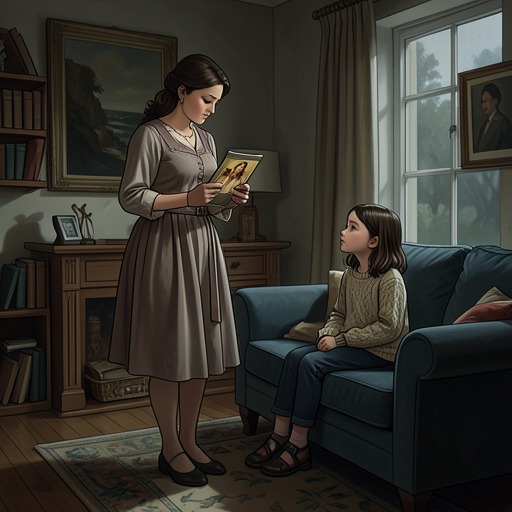
Ima Hart dies
Firefly LaneIma Hart’s death is a decisive rupture in Tully Hart’s early life: the grandmother who raised her and offered a stable home is suddenly gone, leaving Tully to face bereavement alongside her longstanding fear of abandonment. The discovery turns ordinary routines and remembered acts of care into measures of what has been lost; the letter Ima left behind cannot undo that loss, but it makes clear that Tully was cherished. Kate Mularkey’s later comfort gives Tully a way to grieve in the presence of someone who remains.
Discovery and the morning routine
Tully wakes at six o’clock, as usual, and gets dressed for work. She sometimes reaches the office early enough to help one of the reporters with the day’s stories, but before leaving she follows the household rule: she must say goodbye to her grandmother. The familiar obligation brings her to Ima’s bedroom.
In the dim room, Tully can make out Ima’s figure in bed and the coil of her white hair. Her chest is still. Tully moves closer, touches her grandmother’s cheek, and finds that Ima is cold and no longer breathing. The death is discovered not through an announced illness or a farewell scene, but in the space of a customary morning goodbye. Tully’s world seems to tilt as she stands looking at the woman who has been part of her daily life.
A life of care recalled
The discovery brings memories of Ima’s care into the foreground. Tully remembers her grandmother braiding her hair for her seventh-birthday party and telling her that her mother might come back if Tully prayed hard enough. Years later, Ima had acknowledged that sometimes God did not answer a child’s prayers—or an adult’s. The recollections hold both the protection Ima tried to provide and the limits of what she could promise about Tully’s absent mother.
Tully also remembers playing cards with Ima only the week before, laughing as she swept up the discard pile yet again. Ima had gently told her that she did not have to have every card all the time. The small exchange gives their relationship a texture beyond guardianship: they share humor and familiar habits, as well as the larger history of Ima trying to help Tully live with uncertainty. Tully remembers, too, the gentleness of Ima’s goodnight kisses. In the wake of the death, these ordinary gestures become evidence of a care that had been repeated over years.
The letter and the finality of loss
After Ima’s death, Tully finds and opens a letter addressed to her. Ima apologizes and acknowledges how afraid Tully is of being alone and left behind. She writes that she would have stayed longer if she could, and offers the assurance that she and Tully’s grandfather will watch over her from Heaven. Ima also tells Tully that she was the greatest joy of her life.
The letter gives Tully a last expression of Ima’s love, but its past tense makes the finality unmistakable. Tully pauses over the word “Were.” The brief recognition that follows—Gran was gone—marks the difference between being told that she is loved and being able to keep the person who loved her. Ima’s faith offers a promise of continued presence, while the letter itself confirms that Tully must now live without her grandmother’s daily care.
Grief and chosen support
Tully’s loss is compounded by the absence of her mother, Cloud. When Kate returns, Tully explains that her anger is directed at Cloud, Ima, and God, and tells Kate that Ima died while Kate was away. Kate’s response gives Tully what she has been waiting for: someone who loves her and is genuinely sorry for her loss. Tully breaks down in sobs, and Kate holds her without demanding an explanation or trying to end the grief.
That comfort echoes an earlier moment in Tully and Kate’s friendship. When Tully began crying after a frightening experience, Kate hugged her; Tully first found the contact unfamiliar, then clung to Kate, afraid of being left alone. After Ima’s death, Kate again offers physical presence when words are insufficient. The repeated gesture does not replace Ima or resolve Tully’s abandonment fears, but it shows how their friendship becomes a source of care at a moment when Tully’s family refuge has disappeared.
Lasting significance
Ima’s death is significant both as a bereavement and as a change in Tully’s circumstances: the grandmother who raised her can no longer provide the home and daily care on which Tully has depended. The letter preserves Ima’s understanding of Tully’s fear, while the memories of birthdays, prayers, cards, and goodnight kisses make their bond concrete. Together, they frame the loss not as an abstract family event but as the disappearance of a particular pattern of attention and affection.
The event also illuminates the role of chosen family in Tully’s life. Kate’s response is not a substitute for the relationship Tully had with Ima; it is a distinct form of support, offered by the friend who stays beside her and lets her grieve. The contrast between Ima’s permanent absence and Kate’s immediate presence gives the episode its emotional force, while leaving Tully’s fear of being left behind unresolved.